005 · PROJECT
SPINE
SCHEME & SUPPORT NAVIGATOR FOR UPSC ASPIRANTS
THE SCHEMES ALREADY EXIST. ALMOST NOBODY KNOWS WHICH ONES THEY QUALIFY FOR.
OVERVIEW
India funds free UPSC coaching, stipends, and residential academies through ministries, state departments, and universities, but the aspirants those schemes were written for rarely know which ones they qualify for. The information gap, not the money, is the barrier. SPINE matches aspirants to schemes that already exist and routes them to free mental health support.
It started as my final-year capstone (the Support Platform for UPSC Students, project 002). In 2026 I rebuilt it as a realistic proof of concept matching current Indian government web standards: the official UX4G design system, a public-service register instead of startup styling, real scheme names with verified helpline numbers, and a hard honesty rule: no invented beneficiaries, no fake testimonials, nothing that promises a real person real money or a real appointment. I directed the product and design decisions and used AI-assisted development (Claude Code) for the implementation.
THE THESIS
- A navigator, not a provider: SPINE disburses nothing, employs nobody, and is never the application; every scheme links out to its official portal with a last-verified date
- The eligibility matcher is the product; everything else supports it
- Free before paid, always: crisis line first, free counselling before private providers, every price on the card with a free route beneath it
- Honest demo: persistent "no real data" indicator, illustrative amounts marked as such, machine-translated Hindi flagged as unreviewed
WHAT WAS BUILT
- Eligibility matcher: five questions, one per screen, as radio cards; income asked in bands keyed to real scheme ceilings; all state lives in the URL, so results are shareable links and nothing is collected. No login anywhere in the flow. The zero-match state is never a dead end
- Scheme directory: real schemes (MSJE Free Coaching, Rajasthan Mukhyamantri Anuprati, UP Social Welfare coaching, RCAs at Jamia Millia Islamia and AMU) with URL-synced filters, documents checklists, and deadline urgency written in words, never colour alone
- Mental health hub: Tele-MANAS 14416 crisis callout first; every helpline number verified against its official source at build time; free providers listed before paid, with prices on the card and a free-options link under every price
- Honest mocked auth & account: DigiLocker-first sign-in order, no Meta login, prominent "continue without an account"; the applied tracker is self-marked, everything lives in localStorage, and the privacy page explains exactly what that means
- Hindi: full Hindi home and mental-health hub with correct lang switching and Noto Sans Devanagari, honestly flagged on-page as machine-translated and unreviewed
WIREFRAMES
Fifty-two 375px mobile artboards across eight flows. Greyscale, structure only. The crisis link and demo indicator appear on every screen, free mental health options always precede paid, and deadlines are the loudest thing on any card that has one.
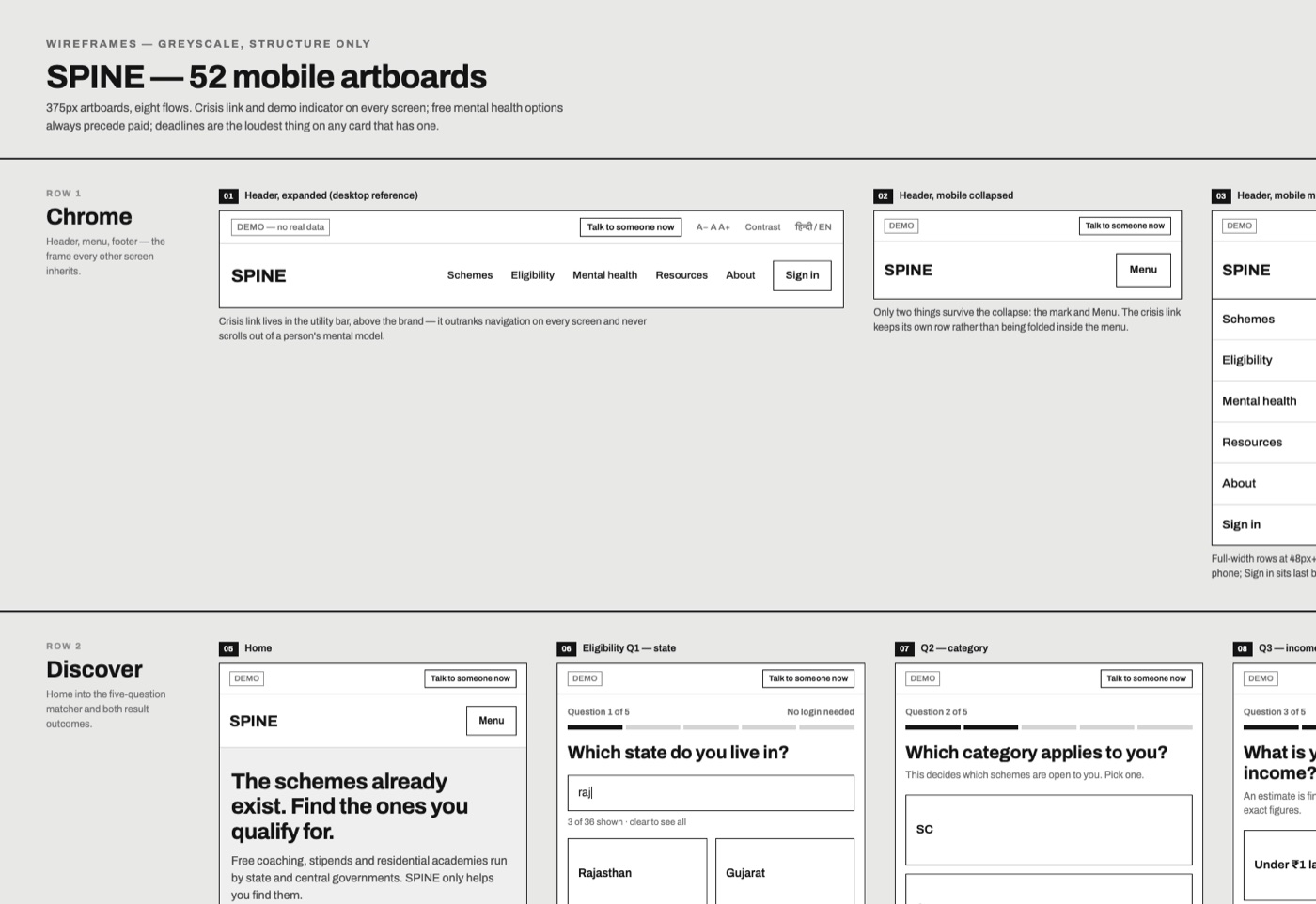 OPEN FULL CANVAS · 52 ARTBOARDS ↗
BY THE NUMBERS
ACCESSIBILITY & ENGINEERING
- Programmatic audit across all 28 routes, fixes applied, then re-verified clean: contrast ≥ 4.5:1 in both themes, one H1 and no skipped heading levels per page, keyboard-complete flows, 44×44px targets, visible focus everywhere, reduced-motion support
- The live accessibility page states what was checked, what was fixed, and what remains open, including that no human screen-reader pass has happened yet
- Next.js App Router + TypeScript; UX4G as the sole design system, with multiple upstream UX4G bugs found, documented, and patched app-side
- The matcher is a pure function with 10 unit tests covering boundary cases; no backend, no analytics, no third-party scripts; every screen checked at 320px, including after the Hindi pass